This page provides a brief overview of external validity inference. For deeper treatments, explore the dedicated pages on Conceptual Foundations, Theory, Design, and Analysis.
The Building Blocks
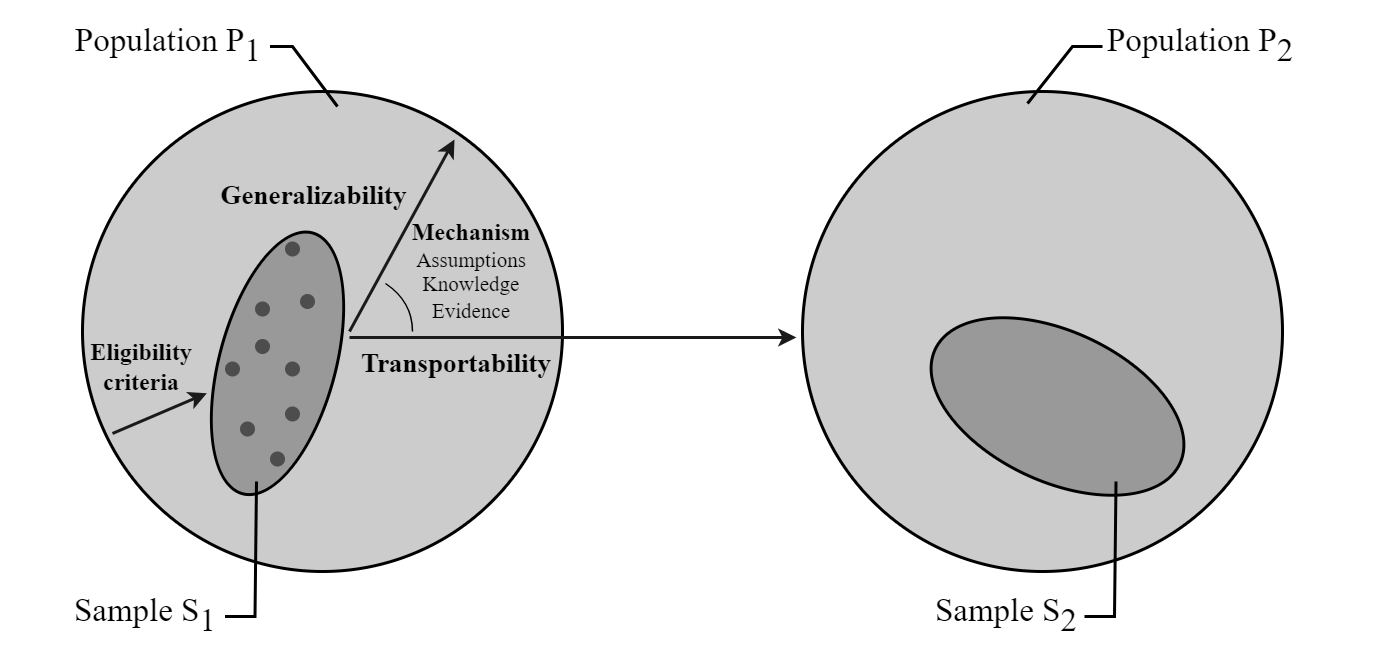
External validity inference rests on assumptions, background knowledge, and supplementary evidence that researchers collect. From these building blocks, researchers hypothesize about mechanisms—the conditions under which inputs lead to outputs at the population level. Mechanisms are foundational because external validity is not about whether an inference travels in binary fashion, but about specifying when and how effects generalize.
Conceptual Foundations
External validity comes in two forms—generalizability (same eligibility criteria) and transportability (different eligibility criteria)—and requires organizing inferences across multiple dimensions. The M-STOUT framework (Mechanisms, Settings, Treatments, Outcomes, Units, Time) provides this structure, emphasizing that mechanisms are the only dimension that can, in principle, travel across all contexts.
Three Inference Criteria
A key contribution of our book is organizing external validity inference around three criteria—each aligned to a stage of the research process. Together, these criteria provide systematic standards for reducing external validity false positives and false negatives.
Model Utility
Theory: How useful is the theoretical model for guiding mechanism-based inference?
Scope Plausibility
Design: Does the study's design align with the populations to which it aims to infer?
Specification Credibility
Analysis: Is the analysis sound enough to support a population-level inference?